Showing posts with label small-batch canning. Show all posts

Saturday, October 18, 2014

bread-n-butter

Thank you, Marisa McClellan, for your obsession with things in jars.  Small batch canning is really the way to go for would be canners on the go.  This recipe is from her Food In Jars, a book I highly recommend to anyone wanting to dabble in putting up.

My local farmer's market had a "last chance" batch of pickling cucumbers, so I couldn't resist the opportunity to make up some pickles or relish or whatever struck me once I got home.  I missed the sweet tang of a bread and butter pickle so I sliced and salted and stuck a bowl (with lid, not pictured) in the refrigerator to wait.

6 cups of pickling cucumbers, 2 cups sliced red peppers, 2 cups sliced onions, 1/4 cup pickling salt
The following afternoon, I rinsed and drained my vegetables and let them sit while I boiled up 2 cups of apple cider vinegar and 1 1/2 cups of sugar.  When the sugar was dissolved, I added my seasonings:  2 tbsp of mustard seed, 2 tsp of celery seed, 1 tsp of red pepper flakes, and 1/2 tsp of ground cloves.  Once the mixture boiled, I dumped in the vegetables, using the 5 minute cook time to set up my sterilized jars and other canning equipment.  Stir occasionally, then remove from heat to fill your jars.

Look how far above the brine this is.  Give it a minute!
And this is 5 minutes later.
At this point, you use your tongs to fill your clean, hot jars with the cucumber mixture.  Carefully fill the jars with the brine, leaving a 1/2 inch headspace.

Marisa's recipe says 5 pints but I don't end up with more than 3 and a snack bowl

Tap your jars on a towel covered counter (you do NOT want hot, sticky pickle juice and broken glass all over!) or use a de-bubbling tool to remove all the air pockets.  Check that headspace and adjust the brine levels accordingly.  Wipe your rims, place your lids and rings on to finger tight, and process in a boiling water bath for 10 minutes.


I remove the lid and let it sit, burner off, for 5 minutes just as a matter of habit after a bad, bad experience with canning tomatoes.  Take your jars out of the canner and let them cool on the counter.

Try really hard to not get into them for 48 hours.  I know, it's difficult, but it will be worth the wait!

For a more detailed, official write up, I refer you to Food in Jars:  Preserving in Small Batches Year-Round by Marisa McClellan

Thursday, February 7, 2013

Pucker Up, Sunshine!

It's kumquat season!  You know, that tiny little fruit you pop in your mouth for a burst of sweet and sour and seed spitting?  Yum!

I picked up a couple of pints at the store this week and after trying them out on my unsuspecting sons (they loved them), trawled the internetz for ways to preserve these little beauties.  Apparently, you can pickle anything!

I borrowed this recipe from vanillagarlic, making my own modifications because really?  Who has cardamom pods in their pantry without prior planning.  I promise, I have a ridiculous spice cabinet.  Especially for someone who moves as often as we do.  But I will have to add the pods.  Apparently, 10 pods equals about a teaspoon of ground cardomom, so we're good.  If you need pods, or even cardomom, I highly recommend the wonderful folks at Savory Spice Shop, based in Colorado with franchises popping up all over the place.  But I digress.

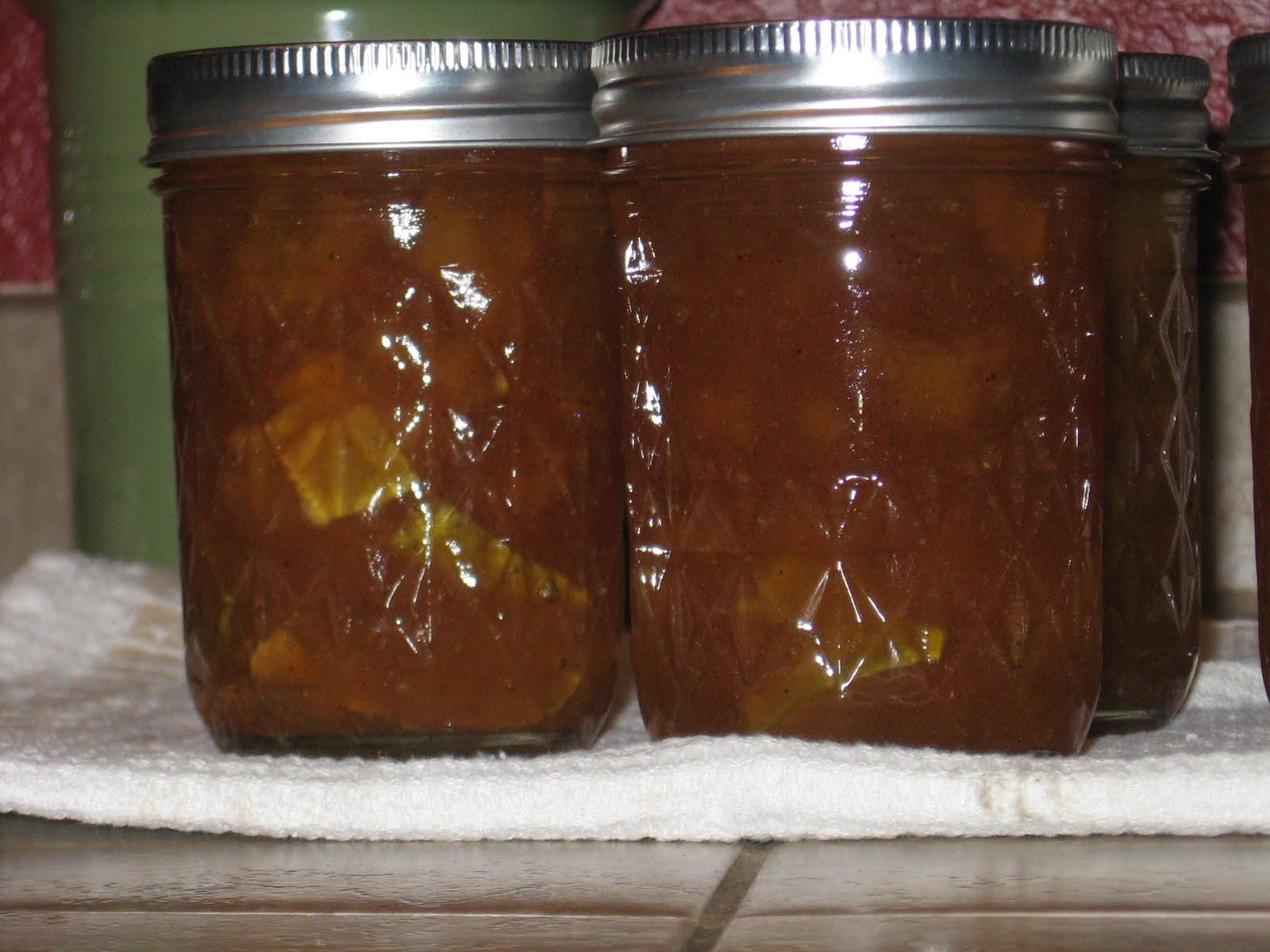
finished product


Pickled Kumquats
(2 pint jars of pickle)

2 pints of kumquats, (about 4 cups), halved with seeds popped out as you can reach them.
1 tsp kosher salt
3 cups white vinegar
1 cup sugar
4 cardamom pods (or about 1/4 tsp ground cardamom)
5 whole cloves
6 black peppercorns
1 tsp ground ginger
1 cinnamon stick, broken in half

Sterilize two pint size canning jars in a small-batch canning pot full of boiling water, place your lids in another small pot with a few ladles of the boiling canning water to soften the seals, arrange your canning equipment for easy access (funnel, towel, little magnetic stick thingie to pick up the lids from the hot water, rings, jar grabber, damp paper towel to wipe the jar before placing the lid, timer, ladle).

After prepping your kumquats, a surprisingly easy task, place them in a 4 quart saucepan, cover with water, add salt, and bring to a boil.  Cover and simmer for 5 minutes while you get your spices together.  Drain and set aside.

Add the vinegar, sugar, and spices to the pan and bring the mixture to a boil.  Add the kumquats back to the pan and simmer for one minute.

Ladle the kumquats into sterilized jars.  Be sure the fruit is fully immersed in the liquid, leaving 1/2 inch head space.  Lid, ring, and process for 10 minutes in the canner.  Remove the canner from the heat and take off the lid of the pot for about 5 minutes, then remove the jars from the canner.

Any extras that did not fit in your two pint jars should be cool enough to eat now!  Warning:  Don't breath in with the pickling liquid in your mouth.  You will cough!

Saturday, October 8, 2011

rounding out September

Cumin and Paprika Pickled Turnips, Chinese Plum Sauce, and Ajvar
So back a week or so ago, I pickled some turnips with paprika and cumin.  I ended up using ground cumin seed instead of the required cumin seed, so cross your fingers!  I halved the recipe from Canning For a New Generation and that all seemed to work out.  My husband had the day off and was a bit put off by the overwhelming vinegar and  cumin smell!

Next up, I finally was able to make that Chinese Plum Sauce I have been wanting to try, having acquired some star anise from Savory Spice Shop earlier in the week.  I copied this recipe down from Put 'Em Up and did note that while I was to "discard the star anise," nothing was said about fishing out the skins.  The immersion blender did not fully puree the skins and the whole affair was somewhat thicker than I'd have thought but it tastes marvelous so there you have it!

Pureed eggplant, peppers and onions for Ajvar

after adding the apple cider vinegar - no, I did not fully peel the peppers, the bitter doesn't bother me and I was in a bit of a hurry :)

Finally, I made some Ajvar from Urban Pantry by Amy Pennington.  I need to get this book for its varied recipes and unique ideas.  Ajvar is a tasty Serbian relish made up of roasted eggplant, roasted peppers, and onions and works well as a dip, a sandwich spread, a pasta sauce, or something to slide in next to your eggs if you roll that way.  I used one single hot pepper which added a fair amount of heat, so the next batch I make up will have only sweet peppers.  It was very simple and something I foresee endless variations on.  Pennington's version is definitely a short cut to what I later looked up online.


Good thing I picked all my green tomatoes last night - this is my back yard this morning!

Saturday, September 10, 2011

why does September always kick my butt?

In my mind, September has always been the "start" of the new year.  This is surely a function not only of the change in weather, but the agriculturally-based beginning of a new school year.  Where we live right now, my September starts mid-August, as the boys head back to school on 15 August.

I have still been canning, just too tired to tell anyone about it LOL.  Here, let me show you!
Ginger Carrot-Radish Slaw
This is amazingly delicious.  I found a very simplified version of the recipe in Put 'em Up!:  A Comprehensive Home Preserving Guide for the Creative Cook, from Drying and Freezing to Canning and Pickling by Sherri Brooks Vinton.  The "slaw" is essentially a refrigerator pickle, using a vinegar/sugar solution and three days time in the icebox to turn into the amazing snack I put brightly on my place next to a few slices of lift.  I have found, in making this several times now, that ginger is a PITA to grate.  I can see why the traditional sharkskin ginger graters would be useful due to the incredibly fibrous nature of the plant.  Has anyone ever made paper out of this stuff?


Apple Pear Preserves

I kind of winged this recipe, using Ellie Topp's Small-Batch Preserving as a guide.  It smells like September to me and tastes divine on dark, dense, whole grain toast.   I remained confounded as to why my jams were becoming thicker than it seemed they should be.  I had never had problems with jams getting, well, jammy before.   Days later, my questions would be answered!

true small-batch preserves - cherries and peaches

I had some fruit beginning to over-ripen on my counter and, inspired by a post by Food In Jars' Marisa and kitchengadgetgirl's Let's Get Sticky post, I took the plunge, chopping up counter fruit and measuring it out.  I had two cups of peaches and one cup of chopped and pitted cherries.  After staring them down for a moment, I decided to not be brave and mix the fruits, although I am fully aware I could have done so and had a great jam.  Instead, I processed them separately, boiling them in a non-stick skillet with an approximately 2:1 fruit:sugar ratio. Two jars of peach and one of cherries later - it worked!  Which is amazing, and I think, in part because I gave up trying to reach the gel point of 220F.  Just as well, because I made my greatest discovery in the world of canning at 7000 ft...the gel point happens at a lower temperature as you go higher in altitude.  Can you picture me banging my head into the desk (figuratively, of course!) repeatedly?  I have known for years, after living in Wyoming and Colorado, that the boil point was lower.  It simply never occurred to me to adjust for gel point.  No wonder my non-pectin jams were too thick!  So thank you, kitchengadgetgirl, for that link at the end of your post.  My jams will be much better for it while I reside in the Rockies!

I have to tell you, a few days later, I met up with some non-cooking-geek friends and mentioned this (to me) monumental discovery...only to have 6 sets of confused and mildly concerned eyes turn to me in unison over their salt-rimmed margarita glasses.  ::Ahem::

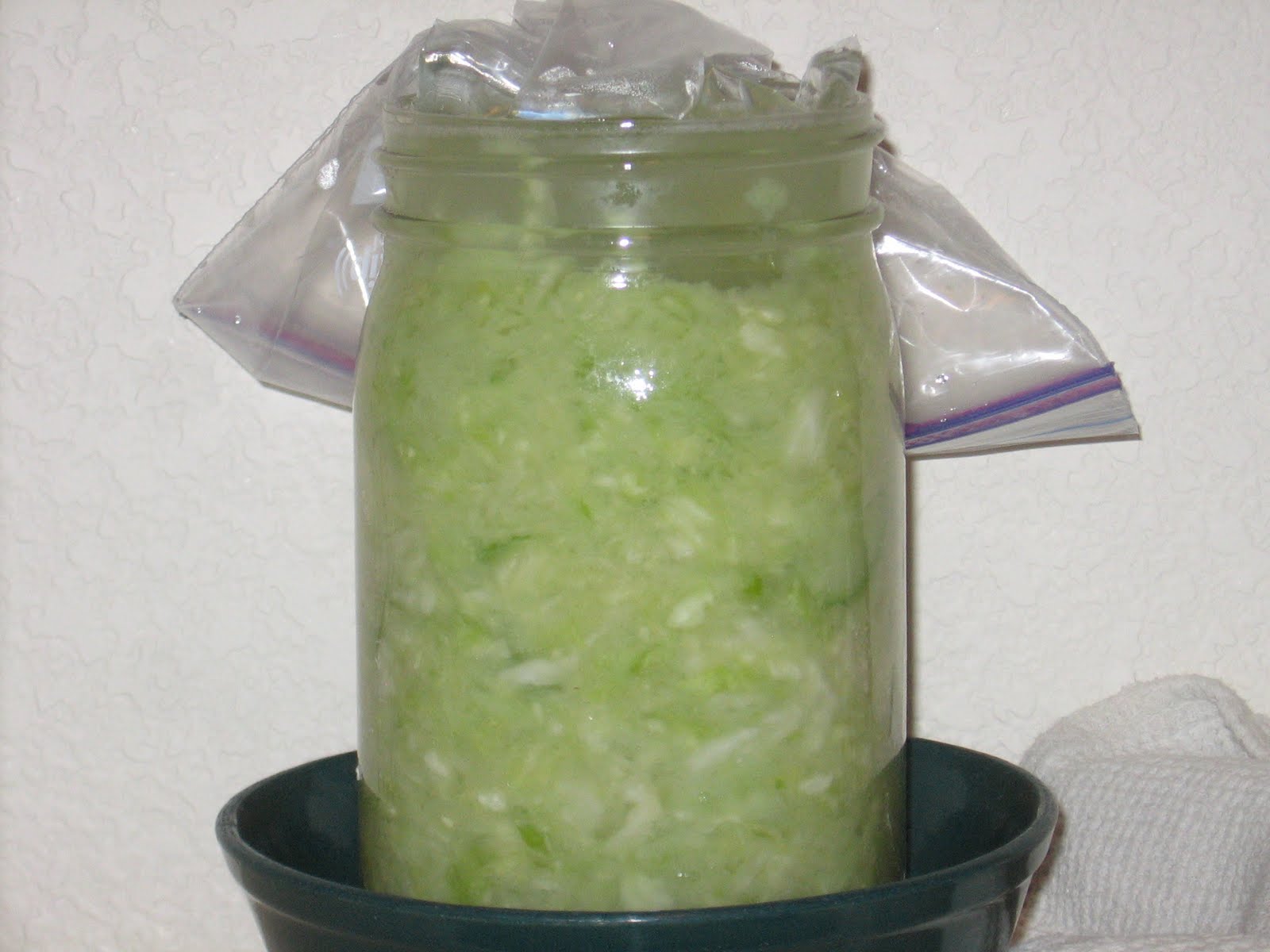
Most recently, I have decided it is time to try the sauerkraut again.  I read Wild Fermentation for some inspiration and went to work on a head of cabbage.  This time, I sliced it thinner, added apple to the mix, reduced the salt slightly, and stuck it on the stairs to the basement where it will be cooler than my kitchen and dark.  I also used a sandwich bag filled with water to ensure everything stayed under brine.  All is quiet so far, but it has only been two days.
sauerkraut - round two
While reading Wild Fermentation, I developed a craving for the sour pickles of my youth.  You know the kind - deep in a barrel, make your tongue curl, crispy sour whole pickles?
sour pickles with dill and garlic
These brine-covered babies joined the 'kraut on the stairs, using the same water-in-a-sandwich bag sink method.  I had to divide it into two half-gallon jars as I lack, for the moment, a gallon-sized container.